2025 WiSe in Universität Heidelberg · Lecture Notes by Offensive77
This post was translated from Typst to Markdown by Claude Opus 4.8. See the link for the original version.
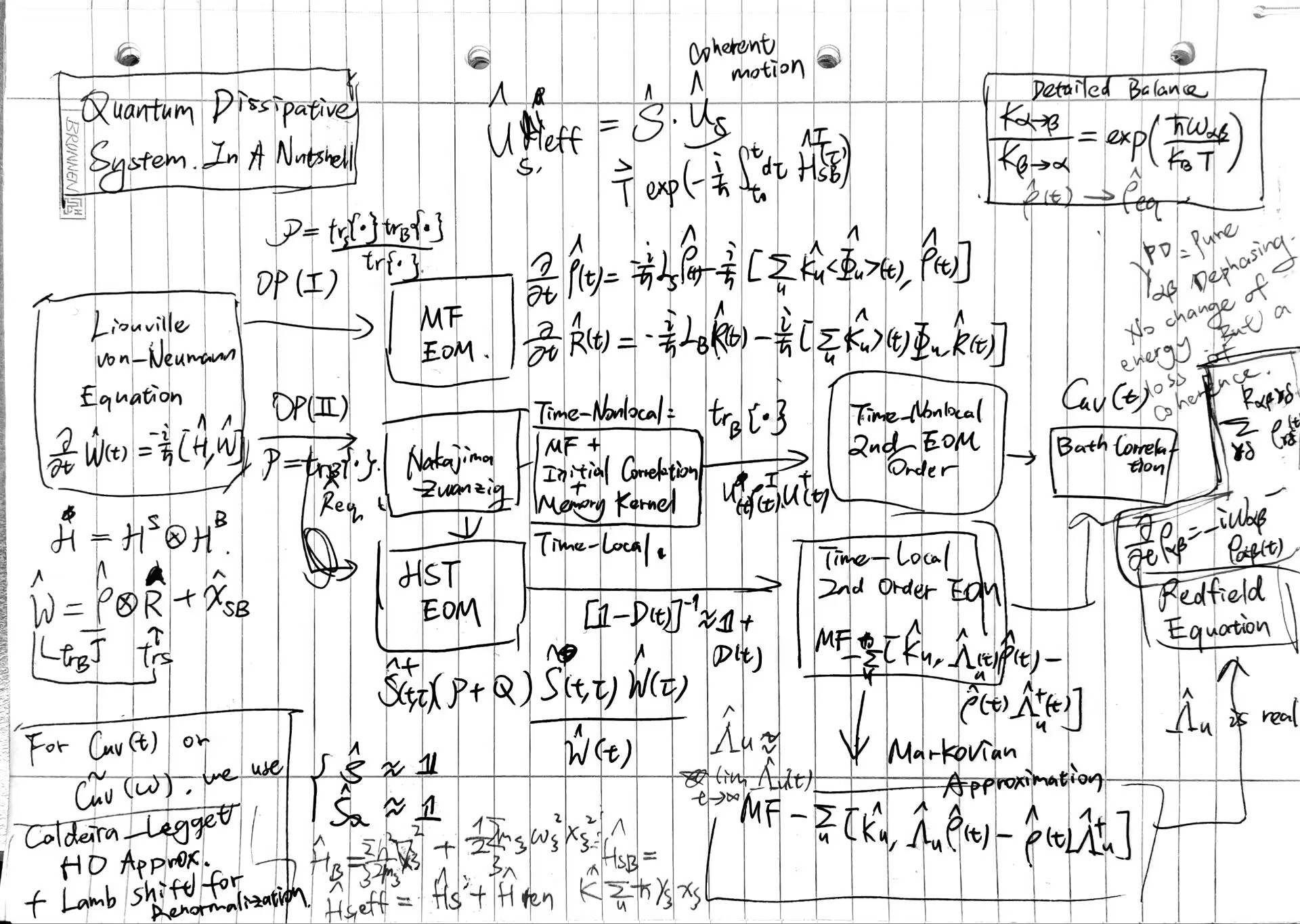
1. Key Tricks Performed in This Topic
1.1. Statistical Operator
Statistical operator (or density operator) reflects the statistical attributes of our system. It works similarly as the probability density function in probability theory. It allows us to define something like expectation and thus correlation.
where
Also, for the energy eigenbasis
- Population:
- Coherence:
Note that:
1.2. Reduced Spaces and Operators
In QDS, we usually separate the system into two parts: what’s relevant and the bath. We are working with the Hilbert space
or strictly,
where
We use partial trace to obtain the system and bath reduced statistical operators, which describes the statistical traits of the subsystem.
Notably, a statistical operator can usually not be written as the tensor product of two reduced statistical operators, i.e.
1.3. Schrödinger
It’s very hard to handle the interaction term
where
Usually, after we obtain some nice results in the interaction picture, we will switch back to Schrödinger picture.
1.4. Orthogonal Projectors
With projectors
2. How We Develop the Theory
- We study the statistical operator, instead of the wave function.
- We start from the von Neumann equation, instead of the Schrödinger equation, to study the time-evolution of statistical operator.
- We take the statistical operator as time-dependent. In other words, we choose Schrödinger picture.
- We insert
3. First Order Perturbation Theory: Mean Field
Let us study the time-evolution of system operator
We know the time evolution of the full system, by von Neumann EOM:
Apply the partial trace
Here,
Insert Equation (1.1) into Equation (3.4):
Define the effective Liouville operator as:
Now, the mean-field approximation arises:
4. Beyond MF: Travel to Interaction Picture
This is only a rough estimation, which is unitary, meaning that it conserves energy (no dissipation at all). Even worse, if the bath is in thermal equilibrium, the time-dependent unitary evolution will devolve into a simple unitary evolution:
Assume the bath is in thermal equilibrium, which means its statistical operator reads
and it is not subject to the changes of our relevant system. Define a new set of orthogonal projectors:
In this part, we try to derive time-evolution in the interaction picture, and travel back to Schrödinger picture afterwards.
4.1. Nakajima–Zwanzig Equation
We can write the similar thing for
Can we exactly solve for
Analysis of NZ equation:
-
-
-
4.2. HST Equation
By insert into the solution of
we can put the integral into a new super operator and get rid of the time-nonlocality of the NZ equation.
5. Exploit NZ Equation
5.1. Time-Nonlocal Second-Order EOM
Taking the trace over bath on the NZ equation leads to:
In practice, we usually assume the initial correlation to be zero. And we approximate
To further evaluate the equation, we need to insert
Note that one can re-write this equation by defining an effective Liouville super-operator that includes the system Liouville operator and the mean-field contributions and an integral kernel as
Eq. (7.2.52) is typically the one implemented within a numerical simulation after the bath correlation functions have been obtained. Our bath correlation function is given by:
It describes the correlation inside the bath. And it will act back to our relevant system by the system operator
5.2. Obtain Bath Correlation Function
In practice, it’s hard to obtain the bath correlation function
Afterwards, we can apply an inverse Fourier Transform to our obtained
6. Analyze the Bath
6.1. Linear Response
Assume the bath is in the thermal equilibrium at
Come to interaction picture by write:
where
and assume
where
6.2. Fluctuation–Dissipation Theorem
We study now the dissipation of bath energy:
Note that the trace over commutators gives 0. The fluctuation around thermal equilibrium, described by
7. Caldeira–Leggett Approximation for Bath
This chapter contains some artificial things to oversimplify our bath.
7.1. Bath as Harmonic Oscillators
The idea is assuming the bath to be a set of Harmonic Oscillator, to obtain our bath correlation easily:
And Taylor expand the bath part of
We then can express the coordinate in creation/annihilation operators:
where
After a lot of math:
7.2. Spectral Density Function
To introduce a more compact form of our bath correlation function, we use:
Then,
Furthermore, by
The spectral density function encodes the strength of absorption at frequency
7.3. Lamb Shift
We may notice that
The derivation is by equating
8. Exploit HST
8.1. Time-Local Second Order EOM
The difficulty in handling the HST equation is the inverse of super operator. However, we can perform the Taylor expansion on it to simplify that:
Do the similar thing we did for the NZ equation as in Section 5.1, we obtain:
where
8.2. Markovian Approximation
The idea is, since
Equation (8.2) becomes now
8.3. Redfield Equation
We skip the technical derivations and just look at the obtained EOM, represented in eigenstates of system Hamiltonian
8.3.1.
This component describes the change of population of state
8.3.2.
This component describes the change of coherence between state
8.3.3. Exponential Decay of Population
Population life-time is given by:
Meanwhile, the coherence life-time is:
8.4. Detailed Balance
By looking at again the transfer rate, we obtain
It ensures that the relevant system reaches thermal equilibrium at long times because there is a thermal weight factor between rates connecting states of different energy. The system will assume a dynamic equilibrium between excitation and de-excitation mediated by the thermal heat bath. Assume that the energy of state