Non-Newtonian Fluid Seminar 01 · Universität Heidelberg
This post is the first part of the script of my seminar talk From Maxwell’s Fluid to the Oldroyd-B Model, translated from Typst to Markdown. The series:
- Maxwell’s Fluid (this post)
- From Maxwell's Fluid to Oldroyd-B (II): Objective Derivatives
- From Maxwell's Fluid to Oldroyd-B (III): Oldroyd-B Model and Weissenberg Effect
1. Introduction
You may have seen this picture in the Moodle page. This is one of the most canonical examples of the strange behaviour of non-Newtonian fluids, the Weissenberg effect.

I am going to answer why this phenomenon happens with Oldroyd-B model. Before that, let’s revisit viscosity and elasticity.
2. What are Viscosity and Elasticity?
Every material sits somewhere between two toys: a spring, which remembers, and a dashpot, which forgets. One stores energy, the other burns it.
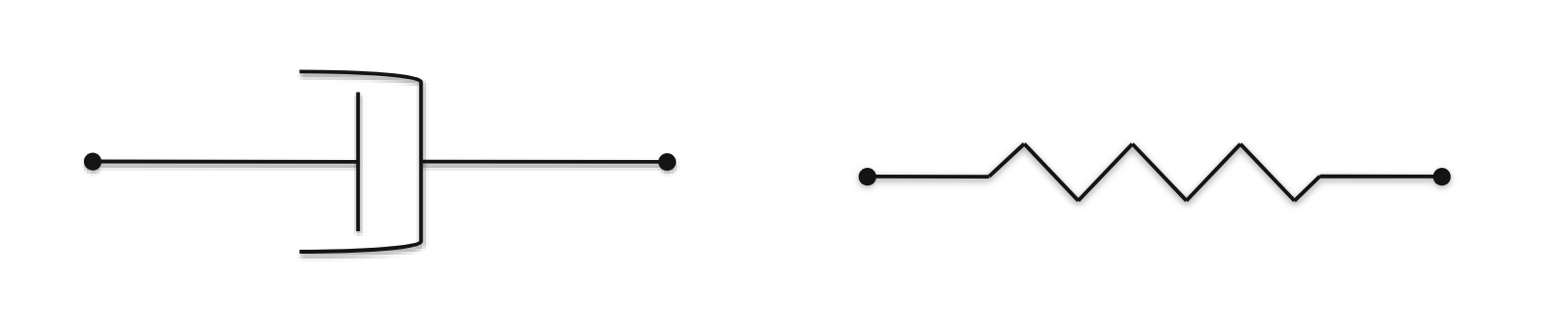
2.1. Spring: Elasticity
Squeeze a spring and it fights back. Squeeze further, it fights harder. Let go, and it wobbles a little and springs right back: a spring never forgets its original shape.
This memory is elasticity: stress depends on how far you deform it, as Hooke’s law says.
-
-
-
2.2. Dashpot: Viscosity
Never met a dashpot? A syringe is close enough. Push slowly and it gives way; push fast and it resists. Let go, and the piston just stays where it is: a dashpot has no memory at all.
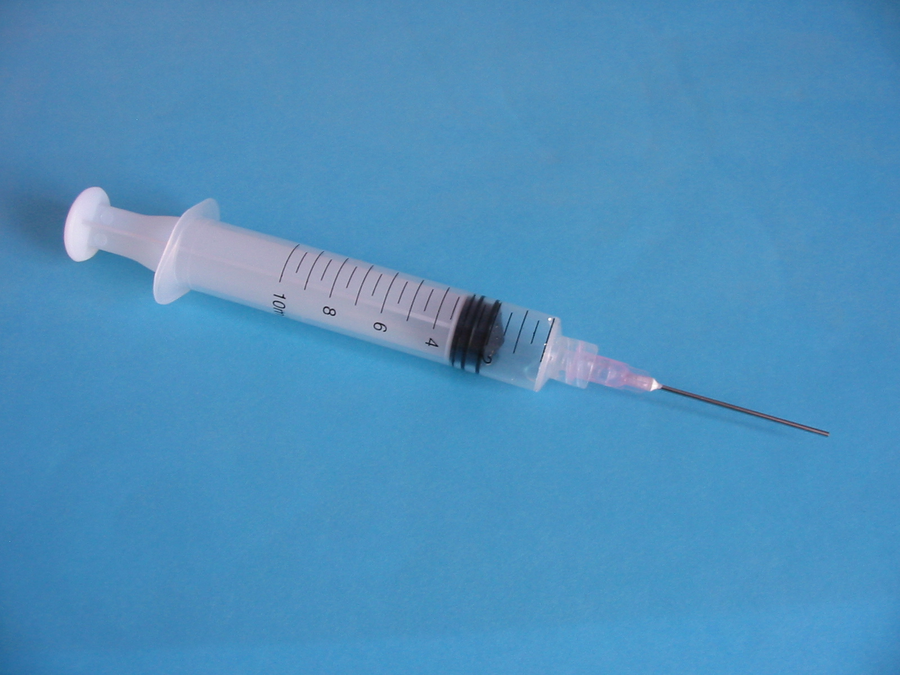
This is viscosity: stress depends on how fast you deform it:
3. Maxwell Model
How to model viscoelasticity? Namely, how to build a model that puts viscosity and elasticity together?
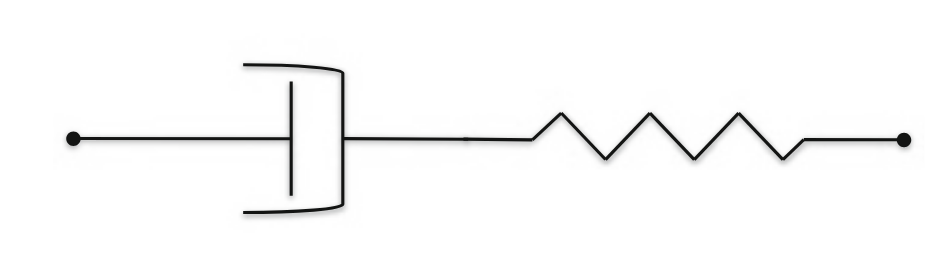
The simplest marriage: hook a spring and a dashpot in series. Like an (electrical) circuit, with stress
Both feel the same stress, but each stretches in its own way, so the strain rates add up:
Multiplying by
where
- poke it fast (
- push it slowly (
3.1. When the Maxwell Model Fails
The Maxwell model is only good for simple deformations, such as linear shear. The transition from scalar to tensorial form is not trivial:
As
We need a time derivative that every observer agrees on. This is the topic of the next post: From Maxwell's Fluid to Oldroyd-B (II): Objective Derivatives.