Non-Newtonian Fluid Seminar 01 · Universität Heidelberg

This post is the third part of the script of my seminar talk From Maxwell’s Fluid to the Oldroyd-B Model, translated from Typst to Markdown. The series:

  1. From Maxwell's Fluid to Oldroyd-B (I): Maxwell's Fluid
  2. From Maxwell's Fluid to Oldroyd-B (II): Objective Derivatives
  3. Oldroyd-B Model and Weissenberg Effect (this post)

1. Oldroyd-B Model

Now we have everything to repair the Maxwell model. Roughly speaking, Oldroyd-B is Maxwell with the UCD [Oldroyd, 1950; Morozov & Spagnolie, 2015]: replace the material derivative τ˙ of the (extra) stress by the upper-convected derivative τ∇=τ˙−Lτ−τLT (see From Maxwell's Fluid to Oldroyd-B (II): Objective Derivatives),

Oldroyd-B Model
(1.1)τ+λτ∇=2ηD.

Every observer now agrees on this law, since τ∇ is objective. To close the system, we let the stress τ drive the flow, which gives the generalized Navier–Stokes equations

(1.2)ρ(∂tu+u⋅∇u)=−∇p+∇⋅τ,∇⋅u=0.
Sanity Check

Let the memory vanish, λ→0 : then τ=2ηD , and we are back at the Newtonian fluid and the ordinary Navier–Stokes equations.

2. Why Does the Fluid Climb the Rod?

Stir water with a rod and the surface dips near the rod: a whirlpool. Stir a polymer solution and the opposite happens: the fluid climbs up the rod. This section explains the difference with a simple force balance.

The setup is shown in Figure 1. A rod of radius R rotates with angular velocity Ω , and the fluid moves on circles around it with speed vθ(r) .
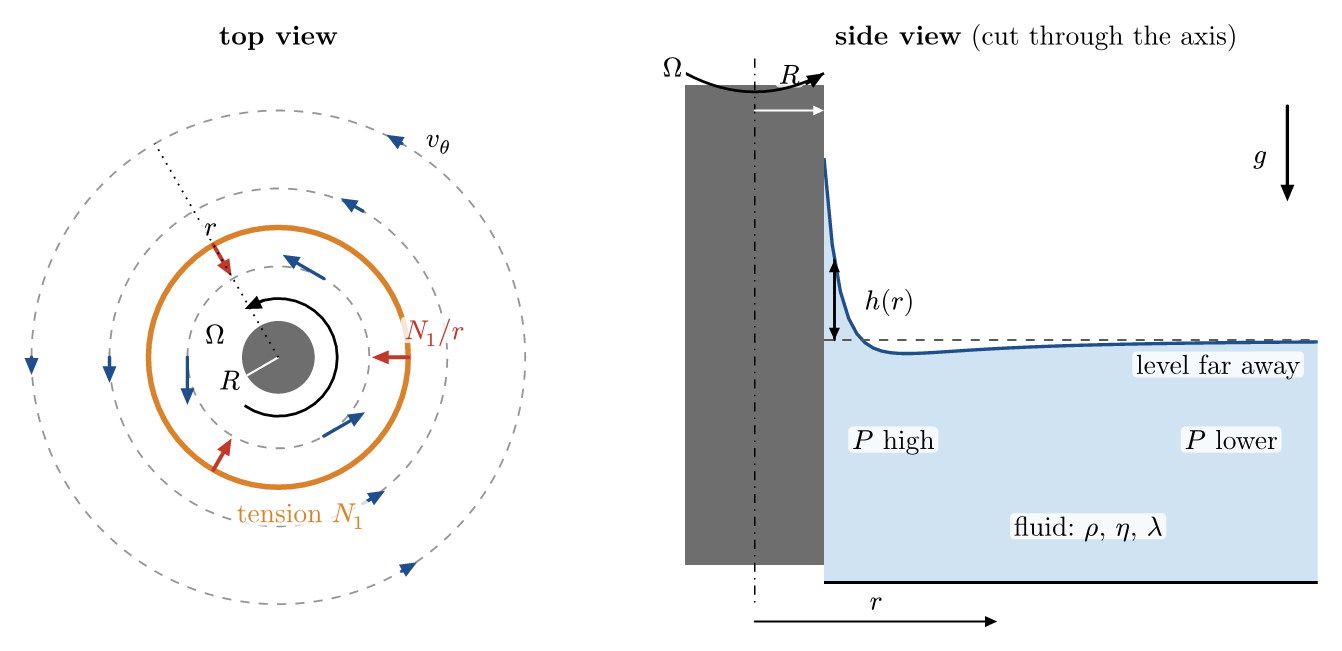
Figure 1. A rod of radius R rotates with angular velocity Ω; the fluid (density ρ, viscosity η, relaxation time λ) moves on circles with speed v_θ = ΩR²/r. Stretched polymers act like a rubber band (orange) with tension N₁ on each circle and squeeze inwards with N₁/r (red). Right: the surface height h(r) follows the pressure P. Drawn for El = 0.6, height exaggerated.

Step 1: The Surface Height Shows the Pressure

Below the surface the pressure grows with depth, p=P(r)−ρgz , where P(r) is the pressure at the height z=0 of the undisturbed surface. On the surface z=h(r) the pressure is atmospheric, which we set to zero. Hence

The Key Observation
(2.1)ρgh(r)=P(r).

The fluid climbs the rod exactly when the pressure is highest at the rod. So we need P(r) .

Step 2: The Forces on a Small Piece of Fluid

Take a small piece of fluid between r and r+dr , with angle dθ and unit height (Figure 2). Its volume is rdrdθ . We list the forces in the direction towards the axis.

  • Required: to move on a circle, the piece needs its mass ρrdrdθ times the acceleration vθ2/r towards the axis.
  • Pressure: P(r+dr) pushes the outer face in, and P(r) pushes the inner face out. The net inward force is P′(r)rdrdθ , i.e. −∇P times the volume.
  • Rubber bands: in a polymer solution, the chains are stretched along the circles and pull like rubber bands with tension N1 (force per area). Each side face is pulled along the circle with N1dr . The two pulls are not parallel: each is tilted towards the axis by dθ/2 , so together they give 2N1drsin⁡(dθ/2)≈N1drdθ inwards.
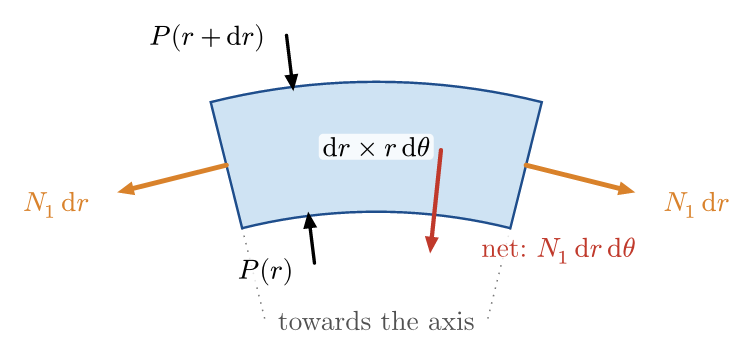
Figure 2. Forces on a small piece of fluid. The two tensions (orange) on the side faces are not parallel; their sum points towards the axis (red).

Newton’s law says that pressure and bands together supply the required force:

(2.2)P′(r)rdrdθ+N1drdθ=ρrdrdθ⋅vθ2r.

Dividing by the volume rdrdθ , and using ∂P/∂r=P′(r) at fixed z ,

Force Balance: Elasticity vs. Inertia
(2.3)P′(r)+N1r⏟tension (squeeze in)=ρvθ2r⏟inertia (throw out).
  • Water ( N1=0 ): only the pressure can turn the fluid, so P′>0 . The pressure and the surface are highest far away: the whirlpool.
  • Polymer solution: if the bands squeeze harder than needed, P′<0 . The pressure piles up at the rod, and the fluid climbs.

Step 3: The Surface Shape

Since I don’t want to introduce too many technicalities, I will directly give you the result:

(2.4)ρgh′(r)=P′(r)=ρvθ2r−N1r=ρΩ2R4r3−8ληΩ2R4r5.

Inertia decays like r−3 , the bands like r−5 , so the bands win near the rod. Far away the surface is undisturbed, h(∞)=0 , so h(r)=−∫r∞h′(s)ds . With ∫r∞s−3ds=1/(2r2) and ∫r∞s−5ds=1/(4r4) ,

(2.5)ρgh(r)=−ρΩ2R42r2+2ληΩ2R4r4.

Dividing by ρ(ΩR)2 and writing x=r/R ,

Surface Height
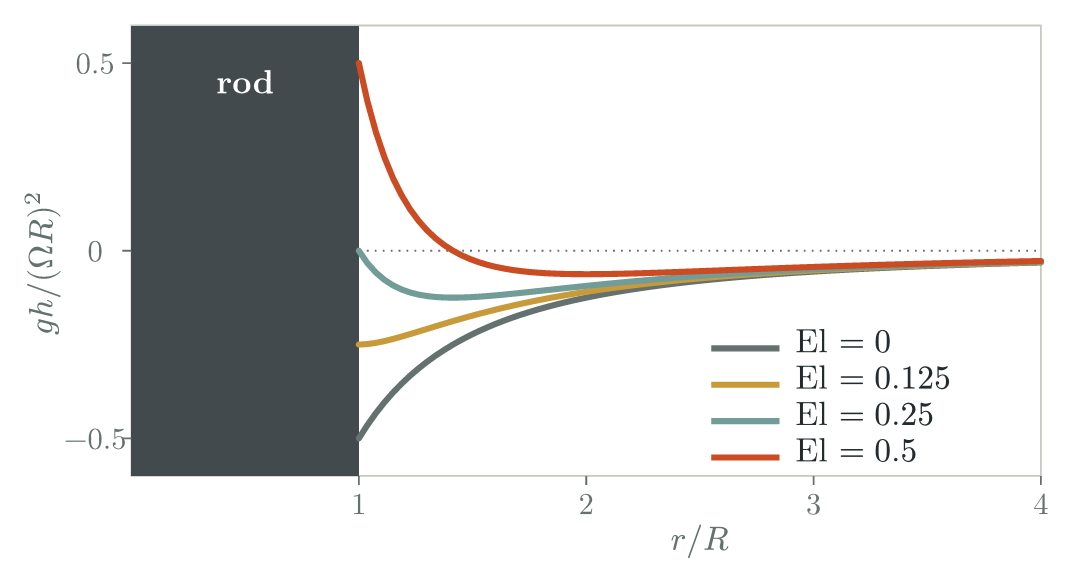
(2.6)gh(r)(ΩR)2=−12x2+2Elx4,El=ληρR2.

At the rod, gh(R)/(ΩR)2=2(El−1/4) , so the fluid climbs if El>1/4 .

Figure 3. Free surface h(r) for different elasticity numbers.
Climb or Dip?

Both terms carry Ω2 , so the rotation speed drops out of the criterion: memory ( λ ) and viscosity ( η ) help, density ( ρ ) hurts, and thin rods climb more easily.

  • Water ( El=0 ): a whirlpool.
  • Polymer solution, thin rod: it climbs!

3. Anecdote: Why not Oldroyd-A?

Oldroyd’s 1950 paper [Oldroyd, 1950] actually proposed two models. Model B uses the upper-convected derivative, as above; model A uses the lower-convected one,

(3.1)τ+λτΔ=2ηD.

In steady shear both give the same first normal stress difference N1 , but the stress points in a different direction:

Oldroyd-B

Tension along the streamlines. The rubber bands squeeze inwards, and the fluid climbs.

Oldroyd-A

Compression across the streamlines. The fluid is pushed outwards, and the whirlpool dips even deeper.

Weissenberg had seen the fluid climb, so B won [Hinch & Harlen, 2021]. This matches the microscopic picture from the boat ride: polymer chains are line elements, and line elements are carried by the UCD.